Saturday, November 17, 2007

William Penn.

My Dear Wife and Children

Warminghurst, 4 August 1682

My dear Wife and Children.

My love, that sea, nor land, nor death itself can extinguish or lessen toward you, most endearedly visits you with eternal embraces and will abide with you forever. And may the God of my life watch over you and bless you and do you good in this world and forever. Some things are upon my spirit to leave with you, in your respective capacities, as I am to one a husband, and to the rest a father, if I should never see you more in this world.

My dear wife, remember thou was the love of my youth, and much the joy of my life, the most beloved, as well as most worthy, of all my earthly comforts. And the reason of that love was more thy inward than thy outward excellences (which yet were many). God knows, and thou knows it. I can say it was a match of providence’s making, and God’s image in us both was the first thing and the most amiable and engaging ornament in our eyes. Now I am to leave thee, and that without knowing whether I shall ever see thee more in this world. Take my counsel into thy bosom and let it dwell with thee in my stead while thou lives.

Ist. Let the fear of the Lord, and a zeal and love to His glory, dwell richly in thy heart, and thou will watch for good over thyself and thy dear children and family, that no rude, light, or bad thing be committed, else God will be offended, and He will repent Himself of the good He intends thee and thine.

2dly. Be diligent in meetings of worship and business; stir up thyself and others herein; it is thy day and place. And let meetings be kept once a day in the family to wait upon the Lord, who has given us much time for ourselves. And my dearest, to make thy family matters easy to thee, divide thy time, and be regular. It is easy and sweet. Thy retirement will afford thee to do it, as in the morning to view the business of the house and fix it as thou desire, seeing all be in order, that by thy counsel all may move, and to thee render an account every evening. The time for work, for walking, for meals, may be certain, at least as near as may be. And grieve not thyself with careless servants. They will disorder thee. Rather pay them and let them go if they will not be better by admonitions. This is best, to avoid many words, which I know wound the soul and offend the Lord.

3dly. Cast up thy income and see what it daily amounts to, by which thou may be sure to have it in thy sight and power to keep within compass. And I beseech thee to live low and sparingly till my debts are paid, and then enlarge as thou see it convenient. Remember thy mother’s example when thy father’s public-spiritedness had worsted his estate (which is my case). I know thou loves plain things and are averse to the pomp of the world, a nobility natural to thee. I write not as doubtful, but to quicken thee, for my sake, to be more vigilant herein, knowing that God will bless thy care, and thy poor children and thee for it. My mind is wrapped up in a saying of thy father’s. “I desire not riches, but to owe nothing.” And truly that is wealth; and more than enough to live is a snare attended with many sorrows.

I need not bid thee be humble, for thou are so; nor meek and patient, for it is much of thy natural disposition. But I pray thee, be often in retirement with the Lord and guard against encroaching friendships. Keep them at arm’s end; for it is giving away our power, aye, and self too, into the possession of another. And that which might seem engaging in the beginning, may prove a yoke and burden too hard and heavy in the end. Wherefore keep dominion over thyself, and let thy children, good meetings, and Friends be the pleasure of thy life.

4thly. And now, my dearest, let me recommend to thy care my dear children, abundantly beloved of me as the Lord’s blessings and the sweet pledges of our mutual and endeared affection. Above all things, endeavor to breed them up in the love of virtue and that holy plain way of it which we have lived in, that the world, in no part of it, get into my family. I had rather they were homely than finely bred, as to outward behavior; yet I love sweetness mixed with gravity, and cheerfulness tempered with sobriety. Religion in the heart leads into this true civility, teaching men and women to be mild and courteous in their behavior, an accomplishment worthy indeed of praise.

5thly. Next, breed them up in a love one of another. Tell them, it is the charge I left behind me, and that it is the way to have the love and blessing of God upon them; also what his portion is who hates, or calls his brother fool. Sometimes separate them, but not long; and allow them to send and give each other small things, to endear one another with once more. I say, tell them it was my counsel, they should be tender and affectionate one to another.

For their learning, be liberal. Spare no cost, for by such parsimony all is lost that is saved; but let it be useful knowledge, such as is consistent with truth and godliness, not cherishing a vain conversation or idle mind, but ingenuity mixed with industry is good for the body and mind too. I recommend the useful parts of mathematics, as building houses or ships, measuring, surveying, dialing, navigation, etc.; but agriculture is especially in my eye. Let my children be husbandmen and housewives. It is industrious, healthy, honest, and of good example, like Abraham and the holy ancients who pleased God and obtained a good report. This leads to consider the works of God and nature, of things that are good and divert the mind from being taken up with the vain arts and inventions of a luxurious world. It is commendable in the princes of Germany, and [the] nobles of that empire, that they have all their children instructed in some useful occupation. Rather keep an ingenious person in the house to teach them than send them to schools, too many evil impressions being commonly received there. Be sure to observe their genius and don’t cross it as to learning. Let them not dwell too long on one thing, but let their change be agreeable, and all their diversions have some little bodily labor in them.

When grown big, have most care for them; for then there are more snares both within and without. When marriageable, see that they have worthy persons in their eye, of good life and good fame for piety and understanding. I need no wealth but sufficiency; and be sure their love be dear, fervent, and mutual, that it may be happy for them. I choose not they should be married into earthly covetous kindred. And of cities and towns of concourse beware. The world is apt to stick close to those who have lived and got wealth there. A country life and estate I like best for my children. I prefer a decent mansion of a hundred pounds per annum before ten thousand pounds in London, or suchlike place, in a way of trade.

In fine, my dear, endeavour to breed them dutiful to the Lord, and His blessed light, truth, and grace in their hearts, who is their Creator, and His fear will grow up with them. Teach a child (says the wise man) the way thou will have him to walk; and when he is old, he will not forget it. Next, obedience to thee their dear mother; and that not for wrath, but for conscience sake. [Be] liberal to the poor, pitiful to the miserable, humble and kind to all. And may my God make thee a blessing and give thee comfort in our dear children; and in age, gather thee to the joy and blessedness of the just (where no death shall separate us) forever.

And now, my dear children that are the gifts and mercies of the God of your tender father, hear my counsel and lay it up in your hearts. Love it more than treasure and follow it, and you shall be blessed here and happy hereafter.

In the first place, remember your Creator in the days of your youth. It was the glory of Israel in the 2d of Jeremiah: and how did God bless Josiah, because he feared him in his youth! And so He did Jacob, Joseph, and Moses. Oh! my dear children, remember and fear and serve Him who made you, and gave you to me and your dear mother, that you may live to Him and glorify Him in your generations. To do this, in your youthful days seek after the Lord, that you may find Him, remembering His great love in creating you; that you are not beasts, plants, or stones, but that He has kept you and given you His grace within, and substance without, and provided plentifully for you. This remember in your youth, that you may be kept from the evil of the world; for, in age, it will be harder to overcome the temptations of it.

Wherefore, my dear children, eschew the appearance of evil, and love and cleave to that in your hearts that shows you evil from good, and tells you when you do amiss, and reproves you for it. It is the light of Christ, that He has given you for your salvation. If you do this, and follow my counsel, God will bless you in this world and give you an inheritance in that which shall never have an end. For the light of Jesus is of a purifying nature; it seasons those who love it and take heed to it, and never leaves such till it has brought them to the city of God that has foundations. Oh! that ye may be seasoned with the gracious nature of it; hide it in your hearts, and flee, my dear children, from all youthful lusts, the vain sports, pastimes and pleasures of the world, redeeming the time, because the days are evil. You are now beginning to live-what would some give for your time? Oh! I could have lived better, were I as you, in the flower of youth. Therefore, love and fear the Lord, keep close to meetings; and delight to wait upon the Lord God of your father and mother, among his despised people, as we have done. And count it your honor to be members of that society, and heirs of that living fellowship, which is enjoyed among them-for the experience of which your father’s soul blesses the Lord forever.

Next, be obedient to your dear mother, a woman whose virtue and good name is an honor to you; for she has been exceeded by none in her time for her plainness, integrity, industry, humanity, virtue, and good understanding, qualities not usual among women of her worldly condition and quality. Therefore, honor and obey her, my dear children, as your mother, and your father’s love and delight; nay, love her too, for she loved your father with a deep and upright love, choosing him before all her many suitors. And though she be of a delicate constitution and noble spirit, yet she descended to the utmost tenderness and care for you, performing in painfulness acts of service to you in your infancy, as a mother and a nurse too. I charge you before the Lord, honor and obey, love and cherish, your dear mother.

Next betake yourselves to some honest, industrious course of life; and that not of sordid covetousness, but for example and to avoid idleness. And if you change your condition and marry, choose with the knowledge and consent of your mother, if living, guardians, or those that have the charge of you. Mind neither beauty nor riches, but the fear of the Lord and a sweet and amiable disposition, such as you can love above all this world and that may make your habitations pleasant and desirable to you. And being married, be tender, affectionate, and patient, and meek. Live in the fear of the Lord, and He will bless you and your offspring. Be sure to live within compass; borrow not, neither be beholden to any. Ruin not yourselves by kindness to others, for that exceeds the due bounds of friendship; neither will a true friend expect it. Small matters I heed not.

Let your industry and parsimony go no farther than for a sufficiency for life, and to make a provision for your children (and that in moderation, if the Lord gives you any). I charge you to help the poor and needy. Let the Lord have a voluntary share of your income, for the good of the poor, both in our Society and others; for we are all His creatures, remembering that he that gives to the poor, lends to the Lord. Know well your incomings, and your outgoings may be the better regulated. Love not money, nor the world. Use them only and they will serve you; but if you love them, you serve them, which will debase your spirits as well as offend the Lord. Pity the distressed, and hold out a hand of help to them; it may be your case, and as you mete to others, God will mete to you again.

Be humble and gentle in your conversation; of few words, I charge you; but always pertinent when you speak, hearing out before you attempt to answer, and then speaking as if you would persuade, not impose.

Affront none, neither revenge the affronts that are done to you; but forgive, and you shall be forgiven of your Heavenly Father.

In making friends, consider well, first; and when you are fixed, be true, not wavering by reports nor deserting in affliction, for that becomes not the good and virtuous.

Watch against anger; neither speak nor act in it, for like drunkenness, it makes a man a beast and throws people into desperate inconveniences.

Avoid flatterers; for they are thieves in disguise. Their praise is costly, designing to get by those they bespeak. They are the worst of creatures; they lie to flatter and flatter to cheat, and, which is worse, if you believe them, you cheat yourselves most dangerously. But the virtuous-though poor-love, cherish, and prefer. Remember David, who asking the Lord, “Who shall abide in Thy tabernacle; who shall dwell in Thy holy hill?” answers, “He that walks uprightly, works righteousness, and speaks the truth in his heart; in whose eyes the vile person is condemned, but honors them who fears the Lord.”

Next, my children be temperate in all things: in your diet, for that is physic by prevention; it keeps, nay, it makes people healthy and their generation sound. This is exclusive of the spiritual advantage it brings. Be also plain in your apparel; keep out that lust which reigns too much over some. Let your virtues be your ornaments; remembering, life is more than food, and the body than raiment. Let your furniture be simple and cheap. Avoid pride, avarice, and luxury. Read my No Cross, No Crown; there is instruction. Make your conversation with the most eminent for wisdom and piety; and shun all wicked men, as you hope for the blessing of God, and the comfort of your father’s living and dying prayers. Be sure you speak no evil of any; no, not of the meanest, much less of your superiors, as magistrates, guardians, tutors, teachers, and elders in Christ.

Be no busybodies; meddle not with other folks’ matters but when in conscience and duly pressed, for it procures trouble, and is ill-mannered, and very unseemly to wise men.

In your families, remember Abraham, Moses, and Joshua, their integrity to the Lord; and do as [if] you have them for your examples. Let the fear and service of the living God be encouraged in your houses, and that plainness, sobriety, and moderation in all things, as becomes God’s chosen people. And, as I advise you, my beloved children, do you counsel yours, if God should give you any. Yea, I counsel and command them, as my posterity, that they love and serve the Lord God with an upright heart, that He may bless you and yours, from generation to generation.

And as for you who are likely to be concerned in the government of Pennsylvania and my parts of East Jersey, especially the first, I do charge you before the Lord God and his only angels that-you be lowly, diligent, and tender; fearing God, loving the people, and hating covetousness. Let justice have its impartial course, and the law free passage. Though to your loss, protect no man against it, for you are not above the law, but the law above you. Live therefore the lives yourselves you would have the people live; and then you have right and boldness to punish the transgressor. Keep upon the square, for God sees you; therefore do your duty; and be sure you see with your own eyes, and hear with your own ears. Entertain no lurchers; cherish no informers for gain or revenge; use no tricks, fly to no devices to support or cover injustice, but let your hearts be upright before the Lord, trusting in Him above the contrivances of men, and none shall be able to hurt or supplant.

Oh! the Lord is a strong God; and He can do whatsover He pleases. And though men consider it not, it is the Lord that rules and overrules in the kingdoms of men; and He builds up and pulls down. 1, your father, am the man that can say, he that trusts in the Lord shall not be confounded. But God, in due time, will make His enemies be at peace with Him.

If you thus behave yourselves, and so become a terror to evildoers and a praise to them that do well, God, my God, will be with you, in wisdom and a sound mind, and make you blessed instruments in His hand for the settlement of some of those desolate parts of the world — which my soul desires above all worldly honors and riches, both for you that go and you that stay, you that govern and you that are governed — that in the end you may be gathered with me to the rest of God.

Finally, my children, love one another with a true and endeared love, and your dear relations on both sides; and take care to preserve tender affection in your children to each other, often marrying within themselves, so [long] as it be without the bounds forbidden in God’s law. That so they may not, like the forgetting and unnatural world, grow out of kindred and as cold as strangers; but, as becomes a truly natural and Christian stock, you and yours after you may live in the pure and fervent love of God toward one another, as becomes brethren in the spiritual and natural relation.

So my God, that has blessed me with His abundant mercies, both of this and the other and better life, be with you all, guide you by His counsel, bless you, and bring you to His eternal glory, that you may shine, my dear children, in the firmament of God’s power, with the blessed spirits of the just, that celestial family, praising and admiring Him, the God and Father of it, forever and ever. For there is no God like unto Him: the God of Abraham, of Isaac, and of Jacob; the God of the Prophets, the Apostles, and Martyrs of Jesus; in whom I live forever.

So farewell to my thrice dearly beloved wife and children. Yours, as God pleases, in that which no waters can quench, no time forget, nor distance wear away, but remains forever.

William Penn


“Wherefore, my dear children, eschew the appearance of evil, and love and cleave to that in your hearts that shows you evil from good, and tells you when you do amiss, and reproves you for it.”

Sunday, October 28, 2007

Neanderthals.

Scientists claim some Neanderthals had red hair and fair skin

Holger Roempler of Harvard University and the University of Leipzig, Carles Lalueza-Fox of the University of Barcelona and Michael Hofreiter of the Max Planck Institute for Evolutionary Anthropology have challenged the commonly-accepted image of Neanderthals, claiming that some of the extinct hominids could have had fair skin and red hair.

Roempler, Lalueza-Fox and Hofreiter have been studying DNA samples taken from Neanderthal fossils found in Italy and Spain. During the course of their study, the researchers had found a mutation that can affect skin and hair pigmentation.

This mutation, according to Roempler et al, reduces the function of the gene known as melanocortin-1 receptor (MC1R), which is one of the key proteins regulating hair and skin color. The catch here is that a slightly different mutation in that gene causes red hair and fair skin in modern humans.

Buoyed by last year's discovery that Neanderthals also possessed the gene known to influence modern speech in humans, Roempler, Lalueza-Fox, Hofreiter and the other members of their team have been continuously working to analyze Neanderthal DNA-dubbed as "the blueprint of life" in the hopes of better understanding these ancient people.

Wednesday, October 03, 2007

Neanderthals

Neanderthals trekked all the way into Siberia

By Will Dunham.

Neanderthals, the stocky kin of modern humans, were far more widespread geographically than previously thought, with some trekking into southern Siberia before vanishing about 30,000 years ago, scientists said on Monday.

Researchers led by Svante Paabo of the Max Planck Institute for Evolutionary Anthropology in Leipzig, Germany, found that Neanderthals spread 1,250 miles further east than scientists had commonly believed.

The scientists used genetic tests to determine that three fragmentary bones previously found in the Altai region of southern Siberia were indeed those of a Neanderthal. They also confirmed that a child's skeletal remains from Teshik-Tash in the Central Asian nation of Uzbekistan were from a Neanderthal.

Scientists previously had established that Neanderthals lived in Europe, the Middle East and parts of Asia before their disappearance, perhaps after some type of competition with modern humans who had migrated out of Africa.

"Intriguingly, their presence in southern Siberia raises the possibility that they may have been present even farther to the east, in Mongolia and China," the researchers wrote in the journal Nature.

Since the discovery in the 19th century of Neanderthal remains in the Neander Valley near Dusseldorf, Germany, scientists have struggled to understand just who were these stockily built archaic humans and why did they die off.

Scientists also are aiming to clarify the evolutionary relationship between modern humans, who left Africa and quickly spread around the world starting roughly 100,000 years ago, and Neanderthals.

"They are our closest relatives," Paabo said in a telephone interview. "If you saw one in the street, she or he would strike you as very robust and muscular, with a big brow ridge and bigger musculature. But they had, for example, just as big a brain as we have."

Traits typical of Neanderthals appear in remains dating from 400,000 years ago, and Neanderthals disappeared about 30,000 years ago, the researchers said.

Paabo, a leader in the field of ancient DNA research, also is instrumental in an effort launched last year to complete a first draft of the Neanderthal genome.

The fact that their geographic range was even bigger than previously thought makes their disappearance all the more mysterious, Paabo said.

Friday, April 20, 2007

Slindon Estate Yard Saw Pit.


The old estate yard at Slindon has many interesting features; it would have been at one time a hive of activity, with carpenters, blacksmiths, all working at there trades supplying the needs of the great house and the estate in general.
Now this has gone, but there are reminders left of this bygone age, one in particular is the saw pit, here wood felled on the estate would be brought to be sawn into planks for various uses, it would have been hard work sawing often massive timbers into planks, and the worse job would have been at the bottom of the pit, for all the saw dust would fall upon you, and the hardest work, for you had to pull the massive saw on the downward stroke, the top man keeping a straight cut.
The saw pit at Slindon will be fully excavated later this year.

Notes.
'Top dog' is synonymous with the similar, if now archaic, phrases, 'upper dog' and 'over dog'. Clearly it is also the antonym of 'under dog' (now usually spelled as a single word) and its synonym, 'bottom dog'.
We have here a golden opportunity for those who consider plausibility to be enough evidence to hang a phrase derivation on. When wooden planks were sawed by hand, two men did the job using a two-handed saw. The senior man took the top handle, standing on the wood, and the junior took the bottom - in the saw-pit below. Add to this the fact that the irons that were used to secure the wood were called dogs and that the bottom position was much the more uncomfortable, and we can jump from this scene to the origin of 'top dog' and 'underdog'.
That may be true. The problem with it as an explanation is that no one has found evidence to back it up. There are printed references to saw-pits and to this form of work, going back to the early 15th century in England and the 19th century in America. None of these have any mention of 'top dog' or 'under dog'. Hardly likely that everyone, including Shakespeare, who referred to saw-pits in The Merry Wives of Windsor, would have ignored these colourful phrases, had they been in use at the time. For example, this extract from the 1876 Yale Review describes saw-pits in some detail makes no mention of 'top dog':
"The saw-pit was a rude structure about seven feet high, made of strong posts set in the ground wide enough apart to hold one or two pieces of heavy pine timber, and the sawyers, one above and one beneath, sawed out one hundred feet per day."
In fact t here are no known references to 'top dog' or 'under dog' in the context of wood sawing until well after the practise was superseded by mechanical sawing.
There are printed references to these terms going back to the days that the pits were still in use, but these all refer to fights of some sort, particularly dog fights. Here's a piece, for which the word doggerel might have been invented, that appeared in several US newspapers in 1859, under the name of 'David Barker':
The Under Dog In The Fight
I know that the world, the great big world,
From the peasant up to the king,
Has a different tale from the tale I tell,
And a different song to sing.
But for me - and I care not a single fig
If they say I am wrong or right wrong,
I shall always go for the weaker dog,
For the under dog in the fight.
I know that the world, that the great big world,
Will never a moment stop.
To see which dog may be in the fault,
But will shout for the dog on top.
But for me I shall never pause to ask
Which dog may be in the right
For my heart will hear, while it beats at all.
For the under dog in the fight.
Perchance what I've said I had better not said,
Or 'there better I had said it incog.
But with my heart and with glass filled up to the brim
Here's health to the bottom dog.

Friday, April 06, 2007

Slindon Estate.

Photos taken on the estate over the past few years are starting to be listed on a web album, click on this link to take you there, more will be added from time to time, .
http://picasaweb.google.co.uk/archresearch

Thursday, January 11, 2007

Life in the Middle Ages.

Daily Life in the Middle Ages.

Daily life for us peasants is generally pretty hard. I get up each morning at dawn, eat a quick breakfast of homemade bread and ale and then I'm off to the fields for a full day of work. We have to plant, tend, and harvest at least one good crop a year or we will starve in the winter. We usually try to plant and harvest at least two crops each year. After working all day, I sometimes stop in the village tavern for a bit of socializing before heading home to have my dinner, and then off to bed.
Elizabeth gets up at the crack of dawn as well. She has my breakfast ready for me before I leave. After that, her day is full. There's the vegetable garden to tend, clothing to wash, bread to bake for tomorrow, cloth to weave, and a house to keep clean. Rebecca and Samuel help her by tending to the animals (we have some pigs, a cow, some chickens, and a couple sheep), and doing other chores. Mathew usually works in the fields with me. He's learning to be a farmer so he can support his own family some day. When Samuel is about 10, he'll come to the fields to work too. Until then, Samuel attends school at the village church to learn some prayers and songs, and how to do a bit of math.
Peasants worked long hours every day, rain or shine, to ensure that their families had enough to eat. Most peasants were farmers, although a few were millers, blacksmiths, and tavern owners. Peasant farmers were the backbone of medieval society. They worked land leased to them by wealthier land holders in the nobility. The farmers produced all of the food, and paid most of the taxes. Their lives weren't all hard work though. They had feasts on holidays, and celebrated births and marriages. They rested each Sabbath day and attended church.
Where They Lived
Peasants lived in small towns or nearby farms on a lord's manor. The average peasant lived in a two room cottage that was constructed of mud plastered branches and straw or of stone and wood with a roof of thatch. The rooms had dirt floors and a few furnishings such as stools, a table, and maybe a chest to hold clothes in the common room. In the other room, sacks of straw served as beds for the entire family. A wealthy peasant might own a bed stand and a few iron pots. In the winter, the common room was shared with the livestock, who helped provide warmth. An open kitchen hearth was also located in the common room. Windows were small slits and didn't have glass in them. The interior of the cottage was lit by candles made of tallow (and probably smelled pretty icky).
What They Wore
The clothing of the peasants and other lower class people was usually made of rough wool or linen. Peasant women spun wool into threads and wove cloth that was turned into clothing for their families. Peasants probably had only one set of clothing, two at most. Men wore coarse tunics, and long stockings or leggings. Women wore long dresses of coarse wool, and stockings. Some peasants may have worn linen undergarments to offset the uncomfortable wool clothing. The outer garments were almost never washed, though the undergarments were laundered regularly. Wood smoke permeated the clothes and acted as a kind of deodorant for peasants. The base for the cloth was usually a russet (brown), so most clothing was a fairly drab combination of browns, reds, and grays, with only small variations. Children were dressed as miniature adults. Both men and women wore wooden clogs or shoes made of thick cloth or leather. In cold weather, peasants would have worn sheepskin or woolen cloaks, woolen hats, and woolen mittens to keep out the rain and cold. Many peasants died during the winter months from over exposure to the elements.
What They Ate
Peasants had a fairly unchanging diet of baked bread, porridge, stew, seasonal vegetables, and some meat. If a peasant lived near a stream or ocean, he may have caught fish to supplement his diet. Otherwise, he ate what he could grow. Peasants mainly grew crops of corn, beans, and wheat. Each family also had a vegetable garden near their home that provided lettuce, tomatoes, peas, beans, radishes, carrots, and other vegetables. Some peasants may have had fruit trees as well. Peasants also harvested acorns and other nuts and berries from the nearby forest. Peasant women made butter and cheese from the milk of cows as well. In the fall, they slaughtered most of the animals for their meat. If it was too rainy or too dry for a good crop to grow, peasant families had a very good chance of starving to death.
Children and Schooling
Birth and infancy were the most dangerous stages of life for people in the Middle Ages. Records from the time period suggest that approximately 20% of women died during childbirth and 5% of infants died during delivery with another 10-12% dying in their first month. Healthy children were regarded as a gift from God. Most families wanted sons, who would one day carry on the family name, as opposed to daughters, who would require a large dowry when they married. However, many parents probably rejoiced at the birth of a daughter as well, especially if they had been childless for many years or their infants had died.
Childbirth during the Middle Ages was very dangerous for both the mother and the infant. When the mother went into labor, a midwife, generally a townswoman who was experienced in delivering babies, attended her. If the delivery went well, so much the better, but in the event of complications the midwife could do very little. There were no Caesarean sections and no advanced medical equipment to help mother and child. Many women died during childbirth and many infants died during delivery.
If both mother and infant survived childbirth, the child was usually bathed in lukewarm water and then swaddled in warm cotton or wool fabric. If it was thought the infant would not live, it was immediately baptized by the midwife or by a man nearby, often the father. If the infant was thought to survive it was baptized several days after its birth in a local church. Here it was named, often after a close relative or a saint, and was promised to be brought up as a Christian.
After the baptism, the child was brought home and life returned to normal. Its mother or a wet nurse generally nursed the infant at home. In peasant families, where every person was needed to work the fields, infants were sometimes left alone in the home for long periods of time, or in the care of a brother or sister who was as young as 2 or 3. Many accidents befell infants left alone or in the care of other children, helping to account for the high infant mortality rate.
If the child lived through the first year, it was soon walking and talking. Young children would have been given small chores like feeding the chickens or washing the dishes, but were otherwise free to play up until the age of around seven. Peasant children whose families were almost always poor wouldn't have had many toys. Fathers and older siblings might make a child a wooden spinning top, a doll, or a set of blocks. Most of the time though, children played with what was available and used their imaginations.
Around the age of seven, children began to learn what they would need to know for their adult lives. Younger male children might attend a village school run by the local church. There they would learn important prayers and songs, and a smattering of Latin and mathematics. When a male child was old enough to be useful, he would go to work with his father or another villager as an apprentice. As an apprentice, the boy would learn everything he would need to support himself and his family. Most male children, especially the eldest, worked the same job as their father. Girl children didn't usually receive formal schooling. Instead, they stayed home with their mothers and learned how to be a good housewife and mother. They learned how to weave cloth, cook, grow vegetables, make butter, clean house, tend children, and other necessary things.
Marriage and Divorce
Marriages of all classes of people were arranged by the parents of the couple. Marriages were contracted to join two families together, and no family would leave such important matters to be decided on the emotions of the people involved. Peasant girls could marry as young as 12 and boys as young as 14. Most of the time though, girls married around 17 or 18 and boys in their late 20's or 30's. The groom was almost always much older than his bride. The prospective bride and groom would probably have already met and known each other for some time as peasants tended to live in or close to the same village their whole lives.
The couple were married in a simple ceremony unlike the elaborate marriage ceremonies today. The actual ceremony differed from place to place. In the early part of the Middle Ages, the Church was not very involved in the marriage ceremony and it was usually conducted at home with several witnesses present. Over the course of the Middle Ages, the Church became more and more involved in the marriage ceremony and by the end of the period, a Christian marriage ceremony almost always accompanied a wedding.
Once the wedding was over, married life began. It was undoubtedly awkward for both the husband and the wife for a time until they got to know each other better. Mutual friendship and respect eventually developed among most married people and sometimes the partners also grew to love each other.
The man was the head of the household in the Middle Ages and the wife was legally his property. A man was allowed and even expected to beat his wife, as long as she lived through the experience. Husbands had complete control over all of their wife's belongings and any other property that was owned by the family. The husband had the final say in all matters. However, many husbands asked for and heeded the advice of their wives.
Husbands were allowed to divorce their wives for many reasons, the most popular being adultery. Wives, on the other hand, could not divorce their husbands. Towards the end of the Middle Ages, this changed slightly, and wives were allowed to divorce husbands convicted of certain crimes or away on a long campaign of warfare. In the peasant class, where everyone knew everyone else, adultery and divorce were less common then in the upper classes where the husband was often gone for long periods of time.
Celebrations and Holidays
Life wasn't all hard work though. The Catholic Church had many holidays that were observed. On these holidays, peasants had feasts, sometimes provided by the lord of the nearby manor, and socialized with their neighbors. They danced, sang songs, and generally had a good time. Peasants also celebrated the birth and baptism of a new child, marriages of family members, and other important events.


References:
• Brooke, Christopher. The Structure of Medieval Society. McGraw-Hill Book Company. New York. 1971.
• Carrol, Sharon. Women's Clothing in the Middle Ages. http://www.millersv.edu/~english/homepage
/duncan/medfem/cloth.html.
• Gies, Frances and Joseph. Marriage and Family in the Middle Ages. Harper and Row. New York. 1987
• The Middle Ages--Clothing. http://www.learner.org/exhibits/middleages/clothing.html
• Oakes, Catherine. Exploring the Past: The Middle Ages. The Hamlyn Publishing Group. Orlando. 1989.
• Reynolds, Laura. Marriage in the Middle Ages. http://www.millersv.edu/~english/homepage/duncan/medfem/marriage.html
• Reynolds, Laura. Marriage in the Middle Ages II. http://www.millersv.edu/~english/homepage/duncan/medfem/marr.html
• Shahar, Shulamith. Childhood in the Middle Ages. Routledge, Chapman, and Hall Inc. New York. 1992.
• Smith, Rebecca. The Medieval Childhood. http://www.millersv.edu/~english/homepage/duncan/medfem/rlspaper.html
• Sobol, Donald J. The First Book of Medieval Man. Franklin, Inc. New York. 1959.
• Stiles, Ben. Clothing Makes the Woman. http://www.millersv.edu/~english/homepage/duncan
/medfem/clothing.html.
• Wincovitch, Christy. A Little About Wet Nurses. http://www.millersv.edu/~english/homepage/duncan/medfem/wet.html

Monday, December 18, 2006

The River Arun.


Visualising the past in 3D: The River Arun

Archaeologists at Wessex Archaeology have completed a 3D animation
that reveals a prehistoric landscape, now submerged under the English
Channel, as it might have appeared 8000 years ago.
At the end of the last ice age the River Arun in West Sussex
flowed a further 8 miles out. Archaeological survey has revealed the
lay of the land, and what plants and trees grew there. The complex
evidence has been turned into a compelling animated tour showing how
the landscape might have looked and how families made a living from
the land and the sea.
The Seabed Prehistory project was established to research ways
of identifying evidence of prehistoric landscapes in and around
aggregate dredging areas. This dredging provides many of the raw
materials, such as gravel, needed for the buildings industry. The
project was designed to see if equipment that is commonly used by the
offshore industry could also identify archaeological remains. It was
an opportunity for archaeologists and the aggregate industry to work
together to gain a better understanding of the archaeology under the
seabed. The results of this project will inform future proposals for
new aggregate dredging licences.
The picture is built up with data collected as part of the
project, or inferred from other research. Geophysical survey
identified the different geological layers in the study area,
revealing the shape of the land. Vibrocores were used to gather
evidence from the buried landscape. Vibrocores are tubes that are
pushed into the seabed. The column of sediment that is caught within
the tube contains layers of ancient soils.
The researchers were able to identify a layer of sediment dating
to the Mesolithic period. This deposit corresponds with a geological
layer found in the geophysical survey. Trapped with those layers were
seeds and pollen from the trees and plants that grew at the time. By
mapping where individual species are found, scientists can plot
particular habitats and so build up a detailed picture of the
landscape.
The video is available on YouTube
(http://www.youtube.com/watch?v=TcGBnVI0gM0).

Wednesday, November 22, 2006

Wilmington Priory.


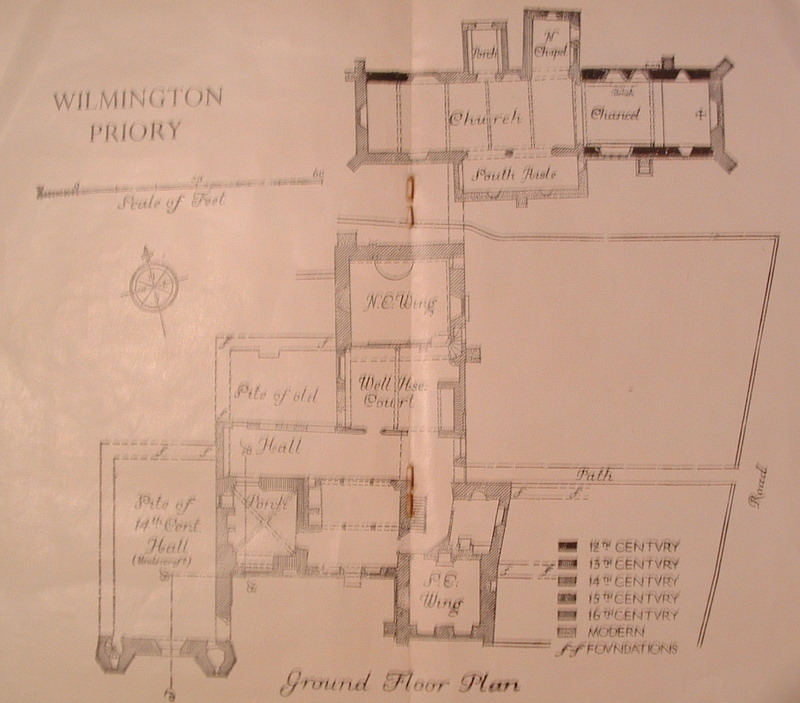
This is from an old quide published by Sussex Archaeological Society 1961.

WILMINGTON PRIORY was formerly one of the possessions

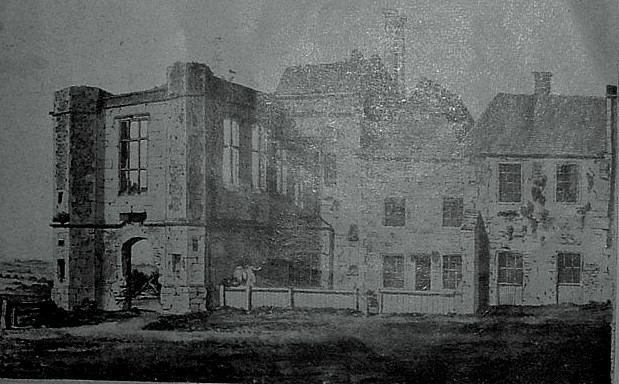
of the Benedictine Abbey of Grestain in Normandy. This Abbey was founded in 1050 by Herluin de Conteville, whose son, Robert de Mortain, accompanied his half-brother, William the Con¬queror, to England, and received from him the Rape of Pevensey. Robert was a liberal benefactor to his father's foundation and amongst his gifts to the Abbey was, as appears from Domesday Book, 1086, the Manor of Wilmington. From its convenient situatjon near the sea, this soon became the headquarters for the Abbot of Grestain's representative in England. The first Prior of Wilmington whose name we know was John who is mentioned in a deed of 1243 in connection with the purchase of lands in Westham. In all probability there were only two Monks normally resident in England and they and their household would live at the Priory, going on journeys from there to inspect the Abbot's other properties. During the wars with France in the 13th and 14th centuries, the King took possession of all alien Priories. He used Wilmington as a source of revenue, letting it to the highest bidder. The object of these lay owners was to get money out of the Priory lands, and naturally, they were apt to let the buildings fall into disrepair. Walter Brystowe was the last Prior; he took the oath of obedience to the Bishop of Chichester in 1401. In 1413 the Priory and lands were granted to the Dean and Chapter of Chichester, and remained in their hands for 150 years. Towards the end of this period (1541) we find that the Vicarage house of Wilmington was in a portion of the old build¬ings. In 1565 Wilmington passed to Sir Richard Sackville and was later let to Thomas Culpepper, who, with his widow and nephew, is buried in the Church. In 1635 another house was built for the Vicar. About 1700 the Wilmington estates passed to Spencer Compton, afterwards Earl of Wilmington, and then by marriage to the Cavendish family. During this time the farmer lived in the Priory buildings. The Duke of Devonshire sold the farm to Co!. R. V. Gwynne and in 1925 conveyed the Priory to the Sussex Archreological Trust, which, under the guidance of Mr. Walter Godfrey, C.B.E., F.S.A., laid out a large sum upon it in necessary preservation work.

From this account of the history of the Priory, it will be seen that the building was planned more like a Manor House than the usual Monastery. But it must be considered as forming one structure with the Church, to which it was connected by the South Aisle of the latter. The 12th century Chancel of unusual length was no doubt the Monks' Quire, while the nave was in use for parochial worship. No part of the 12th century domestic buildings has come• to light, but portions remain of what was probably the Great Hall built in the 13th century (see plan).
After passing through the arched doorway, on the far side of the front lawn (tickets being obtained at the custodian's door immedi¬ately to the left) we turn right through the Well House Court to the North-East Wing, which is now a roofless building but originally of two storeys, with a vault below. The vault is now entered by a doorway leading from the front lawn. This vault, which dates from c. 1300, is larger than the superstructure, which was built a century later, and may have supported the solar of the early house. Notice in the vault the old doorway, with holes for an internal bar. This was probably the way by which stores were brought in. High up in the vault there are three windows which have recesses for shutters. In the room over the vault there are window openings in both the east and west walls and also the remains of a 14th century doorway, which possibly led to a cloister connected with the Church. Against the north wall is the oven of the farmhouse.
The Well House Court was the outer kitchen of the old farm¬house. This Court occupies part of the old Hall and may have been divided off from it when the 14th century Hall was built. It was originally roofed with great oak beams carried on the existing triple stone wall shafts with 14th century capitals. A section of the wall post of one timber truss remains. There is an oak doorway in the south wall. This room was probably the kitchen of the Vicarage built by the Dean and Chapter before 1541.
Retracing our steps and turning right at the custodian's door we pass a timber supported undercroft. On the left is the main entrance doorway of the Hall that consists of three beautifully moulded orders, supported by three shafts on each side and is of 13th century (Early English) work. Adjoining it to the south, is a fine Gatehouse' Of' Porch of two storeys, which is clearly of later date than the doorway, as its vaulting ribs and walls completely disregard the position of the doorway and the windows. There is a similar clash between the outer doorway and the vault, and it may be that there was an earlier porch here contemporary with the doorway and

windows of the old Hall and that it was enlarged when the new Hall was built. The west wall of this room has been largely rebuilt and a chimney inserted. There is, however, in it the reveal of a window with holes for iron bars, which probably represents a hatch com¬municating with the west building. Note the 14th century corbels with heads of monks carved on them.
Leaving the Gatehouse and turning round the left hand comer, we come to the Undercroft of the new Hall built in the 14th century. The Hall was situated on the first floor with rooms below but only the south end and part of the east wall remain. There is a doorway on the east side which seems to have led into the old Hall. In the turrets of, the south wall are spiral staircases. The principal staircase, which was probably at the kitchen end, has disappeared. Stone seats can be seen on either side of the large window, which shows signs of having been altered in the time when the Dean and Chapter had possession. The Tudor bricks used in the western turret show that they did repairs here.
East of the Gatehouse the space between it and the east wing was enclosed on the south perhaps as early as 1500. The south wall of the old Hall seems to have been partly rebuilt in the 14th century and at its east end is a door jamb which was either the entrance to a ground-floor room or to a staircase. The fellow of this jamb has been refixed to form part of the open fireplace in the 16th century kitchen which used to be here. A fine oak chimney beam goes right across it. This kitchen and the room over it are mentioned in Mrs. Culpepper's will, dated 1606.
Passing through a door in the east wall, we enter the inhabited part of the house, where there is an 18th century staircase with a curious balustrade of a Chinese interlacing pattern. This leads to a landing where the rear arch of a 14th century window may be seen with one jamb beside it and also part of the arch of a doorway. This door seems to have led to a gallery running to the east wall of the Prior's Chapel, where is the lower part of the north jamb of a door, or they may both be the doors of separate staircases. Notice the 14th century king-post similar to the one in the Church; it may be seen from the Prior's Chapel, by switching on the light by the entrance to the Museum Room.
Entering the Museum Room notice a large chimney stack inserted in the west wall with an iron wheel fixed to it for turning a spit. Going up some steps we come to the room in the upper storey of the porch which was probably the Prior's Chapel. Here is the greater part of a 14th century three-light east window. There Was at one time an entrance to this Chapel in its west wall leading from the new Hall, but the communicating door has disappeared.

Monday, November 13, 2006

Portrait of the Poor.


Portrait of the Poor
Art Review by Judy Cox,
Review of 'Below Stairs', National Portrait Gallery, London
Wandering through the National Portrait Gallery is always fascinating, and free. You pass kings and queens, politicians, explorers, diplomats, aristocrats and, in the later rooms, sports and film stars.
What you don't see very much of is poor people. Until cameras became cheap, very few working people could have their image reproduced. Portrait painting was overwhelmingly about celebrating the achievements, power and wealth of the elite, with the odd poor poet or footballer made good. But this new exhibition, which you do have to pay for, shows that throughout the centuries a handful of servants did have their portraits painted. And this collection shows them to be a fascinating glimpse of the hidden world below stairs, and class and power relationships.
The earliest portraits date back to the 1600s. These tended to feature the servants in the lord's retinue, just as minstrels, jesters and champions, many of whom would themselves come from high-ranking families. The servants who waited, washed and worked were largely invisible. These portraits tended to come from outlying rural areas of the country where feudal links between master and some servants lasted longer.
By the 18th century households had become more segregated. There was a developing gap between 'upper' and 'lower' servants. Upper servants - such as nannies, gardeners and cooks - often had a close relationship with their masters and had their portraits painted.
In 1790, 90 percent of servants were female. But 90 percent who had their portraits painted were male and most closely associated with their masters' leisure interests, such as gamekeepers.
One of the finest paintings is by Willam Hogarth, famous for his pictures of the darker side of life for the lower classes in 18th century London. Servants became a popular subject in the 19th century, when moralising pictures were the norm. Some show wicked servants getting their just deserts, but others are compassionate pictures of the exhaustion and constant humiliation suffered by many women servants. Some even deal with the widespread sexual exploitation of women servants, brought to attention by Richardson's novel Pamela.
One of the most interesting sections of the exhibition focuses on black and Asian servants. By 1750 there were around ten to 20 thousand black people living in London and other large towns, most brought in as slaves. It became fashionable to have a young black servant boy, and they are painted here like cute little lap dogs. Many suffered a cruel fate when they became too old to be cute and were shipped off to slave plantations.
There is a constant tension that emerges in this exhibition. On the one side is the image of the loyal, trusty servant, like Bridget Holmes, painted when she was 96. Bridget was the 'necessary woman' to generations of royals, emptying their chamber pots.
On the other side were the unruly servants. There seems to have been a constant fear among the 'well to do' that their servants were cheating them, stealing their booze, nibbling their dinners, and disrespecting them. The exhibition includes fierce tirades against naughty servants by the writers Jonathan Swift and Daniel Defoe.
The rich needed servants. They had to be waited on hand and foot and the size of their household was a barometer of wealth and status. But by having servants they brought the class struggle right into their own parlours - and bedrooms, kitchens and stables.
Servants are making a comeback. The numbers employed as domestic workers are going up again, although nothing like the 1931 figure, which showed 1.3 million domestic servants in Britain, most of them women.
Today they are more likely to be the subject of reality TV shows and period dramas. But this exhibition reminds us of how miserable, powerless and poor servants were and how, despite everything, they constantly managed to get one over on those who considered themselves the rightful masters.

Monday, November 06, 2006

Secret Sussex.

Secret Sussex

Smuggling Sussex

Five and twenty ponies, Trotting through the dark—Brandy for the Parson, Baccy for the Clerk. They ask no questions are not told a lie—Watch the wall, my darling, while the Gentlemen go by!
Rudyard Kipling.

A view of smuggling as seen around the turn of the 20th century, expressed by writers of the time often taken and quoted from much earlier writers,
Charles Lamb wrote “I like a smuggler”,” He is the only honest thief.”

As an example of the “respectability” of the smugglers, friends, Alexander Pope, in 1717,writes to John Caryll, a. Sussex squire; “I beg to do me a familiar or rather domestic piece of service. It is, when a hogshead of good French wine falls into your hands-whether out of the skies, or whatever element that pays no customs-that you would favour me with about twelve dozen of it at the price you give,”

Many churchyards in and around Sussex ports bear witness to the constant warfare between the custom men (revenue officers) and the smugglers, they were a mere handfall, but were very brave men, trying to do an almost impossible job. In the churchyard of All Saints, Hastings, is the epitaph of a smuggler, he was shot at sea by a revenue officer. “May it be known, tho, I am clay, a base man took my life away; but freely him I do forgive and hope in heaven we shall live.”

Places of Interest.


Beachy Head is the highest cliff in the South of England, it is very impressive from below as it falls sheer to the beach. The name Beachy has nothing to do with the beach; it is in fact a corruption of Beau Chef.

Belle Tout, The old lighthouse was built in 1831,the great height of the light was an advantage in good weather, but in poor conditions was often a problem to navigators as low cloud would make it become obscured .The lighthouse was built by Jack Fuller, a strange Sussex squire who lies under his pyramid in Brightling churchyard.
Before either of the lighthouses were built there existed, Parson Darby’s Hole, a cave reached by means of steps. There is a lot of uncertainty as to its true purpose. It has been variously suggested that it was built to provide a refuge for shipwrecked sailors, a primitive lighthouse to guild ships, and even a lookout to guide smugglers and keep them informed when the coast was clear.

R.Gunner

Baybridge Canal.

The Baybridge Canal
(River Adur)

Like other Sussex rivers the Adur was a natural navigation route for a long time before the age of the canals, in 1825,the Baybridge Canal Company was formed, this was so that a navigable cut or canal could be formed from the river Adur at Bines Bridge to Baybridge a distance of some 3 ¾ miles.

Strictly speaking, what was built was not so much a canal but an improvement of the north- west arm of the river, this being widened and dredged.
Two locks were built and a small wharf at Baybridge.The northeast arm of the Adur was navigable to Mockbridge, 2miles north of Henfield on the A281.

The canal was built so that the local commodities could be sent to the markets more easier and quicker, this being wheat and high quality timber, especially oak, the canal was in use for about 35yrs,it was abandoned in 1875,but it had not really been used since around 1861,about the time the Shoreham-Horsham railway line opened.

The Canal is worth a visit, there are various areas that have survived the passage of time, the best preserved part is the Lock at Partridge Green, here can be found a brick lock-chamber, the brickwork is very fine, also there are remains of iron fitments. The best way to explore this canal is to walk the entire length, from Baybridge to Binesbridge a little over 3 miles ,refer to OS sheet197,or any good map of Sussex.

R.Gunner

Parkminster.

Parkminster

In February 1873 Mr Boxall of Parknowle near Cowfold stood on his doorstep ready to receive the man who had bought his house, a Russian baron and general.
The buyer was indeed Baron de Nicolai but he was also a Carthusian Monk!
The order had thought it unwise to inform Mr.Boxall, who was known to be a strong protestant, of the true identity of the buyers. It was said that Mr.Boxall did see the funny side of it.

In the succeeding years the country house became an impressive Cathusian monastery and ten years later the monks settled down to regular life under their first prior Don Victor.Parkminster as it was now known, became the first Carthusian monastery in England since the sixteenth century and has remained until only very recently the only Carthusian monastery in the English speaking world.

Parkminster is dedicated to Saint Hugh who was prior of the first English Charterhouse in 1178, Hugh who later became Bishop of Lincoln is justly remembered for his bold defence of the poor and his stand against Kings and Barons
A stole, worn by him is kept at Parkminster.

The life of a Carthusian monk is strict; the monk lives almost entirely on his own in a “cell” which in fact is a small two-story house. He believes that he has been called to this life. There are some thirty-five cells at Parkminster; each has a workshop on the ground floor and a small garden. He studies, and prays, and sleeps on the first floor.
The monk may at times visit the library and the chapel; he may also on special occasions take exercise outside the monastery. Occasionally the white habited monks can be seen walking in pairs around Cowfold, Shermanbury, and West Grinstead

Rodney Gunner.

Sunday, July 23, 2006

Phil Harding.


Phil Harding archive article, on his interest in Flint knapping
It has been recovered from an old IBM disc, written using wordwise.

Flint is 98% amorphous silica which sometimes encloses fossils or micro fossils. Flint is always found in association with chalk although its origins are less understood. The biological origin of the surrounding chalk matrix is undisputed so the fact that flint is found within chalk and the fact that many creatures of the zooplankton have salicaceous exoskeletons strongly suggests a biological origin for flint but gives no hint as to how the silica is concentrated and mineralized into glassy nodules.
Flints have been worked since the beginning of human prehistory, either won directly from the chalk or gathered, washed and smoothed, from river beds. Tool making and tool using has been implicated in the development of human intellect, human appearance and human physique. That the soil on which early man stood and one of the minerals he first used should both be composed of the recycled remains of earlier life forms are just two of many observations that beg an anthropic explanation of our worlds origin and development.
Whilst I have known these facts for years Synchronicity (an acausal connecting principle -- the simultaneous occurrence of two meaningfully but not causally connected events -- a coincidence in time of two or more causally unrelated events which have the same or similar meaning) has conspired to reawaken my interest in stone age technology.
Reading 'Stig of the Dump' and 'Tool Maker' to Marie was the first link of a new chain of coincidence.
Years ago as a teenager I was involved in excavating the debris cone of a Deanne Hole. Dene holes are common features of chalk lands in the South East of England. They consist of vertical shafts that widen out into cloverleaf chambers thirty feet or more below the surface. For many years there was controversy about how or why they came to exist. One idea was that they were natural cavities cut through the chalk by acidic water, possibly later enlarged by man. Other suggestions were that they were dug by Druids for religious ceremonies or more recently, in the 17th century, as hidy holes for priests or royalists. The final consensus was much less fanciful. It is now believed that they were chalk wells dug in that form to minimise the labourers effort. The vertical shaft reduces the amount of top soil to be removed, or disturbed, to get at the chalk. When the shaft has been sunk to its maximum depth, deep enough to make the roof safe and self supporting, several men worked outwards and upwards in different directions so the chalk they cut fell down and back coming to rest below the centre shaft where it could be loaded into baskets hauled straight up to the surface. The clover leaf shape was the result of the miners working outwards in different directions.
The subject of early man came up again when our American relatives were here, in England, for their summer holiday. A wet Sunday at the end of July produced the simultaneous suggestion, from our two families, of visiting Chislehurst Caves in Kent. Following an official guide we learnt that the caves were miles of man made tunnels, dug through the local chalk in various periods of history, including Celtic, Roman and modern times. Some of the tunnels were started as Dene holes which were enlarged and then linked up with other tunnels or Deanne hole complexes. The caves were excavated for various purposes, including the mining of flints to Knap for flintlock guns and tinder boxes.
On Friday the 4th of August, for the first time in months, I looked through the radio section of the next weeks radio and TV times. I noted the listing of a program called 'The flint Knappers Tale' a conversation with Phil Harding - Flint Knapper. The programme was to be broadcast on Saturday the 5th, with a repeat on Monday the 7th. I missed the Saturday broadcast. On Sunday the 6th of August we, and our American in-laws drove to a craft and country fayre held near Guilford in Surry, this was in part because it was there and in part to meet up with some other relatives. The other relatives were in the process of moving from their previous address but were not fully moved into their new home and the fayre was conveniently placed to meet them, near but away from their new house. At the fayre there were demonstrations by many traditional craftsmen including potters, thatchers, wheelwrights, blacksmiths, wool spinners and wood turners. Then I discovered, sitting by himself on a chair, out in the sun, Phil Harding - Flintknapper. In appearance he looked like an aging hippy with long hair tied back behind his head. He wore tatty Doc Martins and rough khaki trousers but was naked from the waist up, his face and torso both looked used to being exposed to the elements. About his neck was a leather thong with a barbed, flint, arrow head hanging from it. Some examples of finished tools were displayed on a table beside him, tools he had knapped from flint, and in some cases also ground and polished, While I gathered first impressions P.H. silently worked a piece of flint, selected from a pile behind his chair. His booted feet were becoming immersed in a growing mound of flint shards as he worked the initial lumps of flint into blades, sharp edged slivers of flint that could be used as they were or else be further worked into such items as arrowheads, scrappers or piercing tools. When questioned he was happy to engage in conversation. Phil Harding lives in Whiltshire and has the appropriate accent. Through conversation and observation that afternoon, and finally by listening to the radio programme on Monday 7th August, I learnt a lot about flint, flint knapping and the flint Knapper. He described himself as a semi professional Flint Knapper. It transpired that he had obtained a qualification in archaeology seventeen years ago and his day job often involves sorting and identifying prehistoric artifacts. Knapping flint helps Phil to understand and appreciate the work of our stone age ancestors. He also makes money providing a service that few others can offer. It isn't just stone age tool replicas that are required, older buildings, or copies thereof, may be finished in flint or have flint quoins or mouldings. Ancient though the use of flint is, it defies working with 2Oth century tools so knapping will never quite disappear. A recent commission given to P.H. was to manufacture 12 metres of flint mouldings for a Sussex College building which was designed to blend with earlier architecture. The specification required a cross section to the flint that P.H. would have claimed impossible to produce by knapping, except for the recent unearthing of a long lost cargo of flints, exported from Grimes Graves when knapping was still HiTec.
To work flint P.H. sits with a core on his knee or in his hand. He hits the core with a hammer which is either a harder stone or softer bone or antler. He protects his hand and his knee with a piece of leather. His eyes are not protected though his bag contains safety specs, he claims he uses specs when on his own but doesn't like to spoil his macho image in public. The choice of core and hammer comes down to experience and the intended end product. Flint is a difficult material to `read', pieces with major flaws can be discounted by the dull noise they make when struck but many apparently faultless flints shatter due to internal stresses or microscopic flaws. It isn't always essential to use a hammer harder than the flint as flakes can be removed by applying sufficient pressure to the right point, and the correct angle. The effectiveness of the end product was shown by small cuts that Marie and James sustained by handling flakes, then I used a larger flint flake to split an apple, using less effort than if I had been using a kitchen knife. P.H. claims to have used flint tools to chop small trees and to skin a Roe deer (the animal had not been killed for the purpose). The absolute worth of flints as tools is something he doesn't like to be drawn on, for as he says it was irrelevant when there was no alternative and when the raw material for new tools was immediately to hand, when the need arose. He also believes that the degree of finish of many museum exhibits indicates they were prized by their owners for reasons other than their practical efficiency.
Some archaeologists have made extended studies of how early men made and used their tools. Nicholas Toth examined the volcanic lava implements made at Koobi Fora (Northern Kenya) to find out such factors about their makers as whether they were right or left handed. N.T. has used stone implements for butchering big game, including elephants, and also for digging the ground so he could find the strengths and limitations of various types of tools. In practice many were found to be surprisingly efficient. Perhaps we should not be surprised by the efficiency of flint tools as electron microscopists still use glass `knives' for cutting ultra thin sections. Glass is chemically and physically similar to flint and `glass knives' are used in microtomes because freshly broken glass is sharper than steel, but the knives have to be replaced frequently because the glass will not keep it's edge.
Stone age hunter gatherers societies with low population densities would only live in areas where food was relatively plentiful, otherwise they would move on. This means that even without vacuum cleaners, washing machines, freezers or other modern labour saving devices they ought to have had an excess of leisure time to invest in making implements which were aesthetically pleasing, over and beyond any improvement in function. The importance of stone and stone tools to hunter gatherers is demonstrated by the fact that scientific examination of raw stones, part worked stones and finished stone artifacts shows they were often transported considerable distances from their point of origin.
I am fascinated by stone age technology because flint working was mankind highest technology for thousands of years and has remained the highest technology for some primitive peoples until the present day. If some global catastrophe could end modern western civilisation, without destroying all of humanity, flint knapping may yet again become man's supreme technology. As Einstein once remarked "I don't know what weapons will be used to wage the 3rd World War but I am sure sticks and stones will be used for the 4th." Thousands of years after our history has ended stoneware will make up the bulk of remains left for our successors, or visiting aliens, to evaluate our civilisation.

Note.
All means possible have been unsuccessful in identifying the original author.
Full credit is given in absence.


Thursday, June 29, 2006

Ancient history of trips to the dentist

Ancient history of trips to the dentist.An interesting article.Click link to view.
Click.http://www.britarch.ac.uk/ba/ba43/ba43feat.html

Monday, June 05, 2006

Church Archeaology.

A Future for Historic Church Buildings.


The English Heritage Inspired! campaign is the
most strategic and ambitious attempt yet to
tackle the problems facing this country’s
14,500 historic places of worship and is
supported by all the faith groups with listed
buildings in England.