Thursday, February 06, 2014

W.A./S. History.

1962 to 1972.

THE HISTORY OF WORTHING ARCHAEOLOGICAL SOCIETY 1962 TO 1972


To start this decade, it was noted in the minutes of a meeting on the 16th January 1963 that Con Ainsworth had joined the Society and by November 1963 he had been elected to the Committee. In January 1965 it was reported at the meeting that the Research Committee of the Sussex Archaeological Society wanted a representative of Worthing Archaeological Society to serve on their Committee, and it was unanimously agreed that Con should be that person.


In 1964 an investigation at Binsted commenced and ‘developed into a full-scale research dig when the importance of the site became apparent’, also it was the first Medieval kiln site to be excavated in West Sussex. Under the direction of Con, work took place twice a week throughout the year. He found two main structures, a semi-circular kiln for firing pots and a large rectangular tile kiln, which was in a ‘unique state of preservation, the firing chamber arches being largely intact and a portion of the oven wall still surviving’. Huge amounts of pottery were recovered including fine Sussex Ware: green-glazed and highly decorated jugs with face masks and annular brooch design, and Coarse Wares. All the raw materials for pottery and tile making had been available at the site. There is even a report of documentary evidence from the Lay Subsidy Rolls suggesting that the operators of the kilns in 1332 may have been Will Atte Potte and John le Tyghler, who were recorded as living in the Hundred of Binsted.

By November 1966, magnetic reading gave an earlier date for the kilns than the archaeological evidence suggested. By January 1968, the site was being filled in.


In the autumn of 1968, Con was carrying out a limited excavation at Tortington to determine the ‘nature of the magnetic anomalies’ detected in a gradiometer survey which had been carried out in 1967. In Con’s report, which was included in the Annual Report for 1968/1969, he suggested that the site might possibly be a 14th century moated site. An area 30 feet by 30 feet had been stripped which was determined to be a possible kitchen area of a larger building, the sources of the anomalies being two hearths and two ovens.


Not all excavations are reported in great details in the Minutes or the Annual Reports. For example at a meeting in April 1969, the Minutes state that Con reported on a 16th century well at Applesham Farm and pottery from salt mounds. The Minutes for a meeting in April 1971 state that a Roman cremation burial was found near the back door of the Marquis de Granby public house in Sompting and the finds included two cremation urns and pottery all of Samian Ware. At the same meeting he spoke of New Monks Farm in Lancing just west of Shoreham aerodrome, where a large number of salt mounds and one of Medieval occupation were found. The pottery included that of late Saxon and early Medieval. And in 1971, excavations at a Roman temple in Pulborough revealed finds of fragments of painted plaster. The coin and ceramic evidence confirmed the date of the destruction of the site as late 4th century. The destruction of the site was indicated by the masses of concrete flooring dumped into pits and ditches, together with wall masonry of Pulborough Stone and roofing tile.


Con not only directed excavations. His lectures for the Society included one on Rescue Archaeology in March 1972, where he showed slides of rescue work in towns and on motorways by various local archaeologists. ‘All societies must be ready to do this important work’.

He was also a speaker at the one-day conference at Brighton College in November 1970, but unfortunately the Minutes do not say what his subject was.

And finally, after having been a member of the Society for less that ten years, Con was elected President for the year 1971/1972.


During the digging season of 1962, the Society did not undertake any excavations. Worthing Museum however, carried out a rescue excavation at Steyning with the help of some Society members, where a sequence of settlement dating from the 12th century to the late 17th century was uncovered. Members also helped again in 1963 by observing building sites and various kinds of public works. These works included the laying of water mains between the junctions of Farncombe Road and Selden Road, which exposed a series of five ditches and a habitation area and produced finds of Roman pottery from the 1st and 2nd centuries.

At Tarring recreation ground, one cable-laying site produced Medieval pottery with a small scattering of Roman material mixed in.

A building site in Marlborough Road exposed a long layer of daub and charcoal which had the appearance of being prehistoric, but unfortunately no dateable material was found.

Members helped Worthing Museum again this year at Goring Methodist Church where the complete foundations of a Medieval house and portions of two others were excavated. Pottery proved to be 14the century. Other excavations with the Museum were at Selden Woods, Steyning and the site of the old St Paul’s Church.

This joint effort continued during 1964 at Offington Hall, Erringham near Shoreham, where a Saxon weaving shed was found, and Wiggonholt near Pulborough, which was the major undertaking, sponsored by the Ministry of Works and Buildings. Widening of the A283 revealed evidence of settlement to the north and south of the Roman bathhouse, which was excavated by Mr Winbolt in 1937 and 1939.

Dr Ratcliffe-Densham reported the finding of  a previously unknown type of prehistoric horse at Selsey during low tide, and also of a skeleton found in a Roman ditch in Sompting, both in 1965.

Excavations during 1965, apart from the kiln site at Binsted under the direction of Con Ainsworth, were at Maison Dieu in Arundel. This was another rescue excavation before the construction of an access road for the Post Office. Maison Dieu was built in 1396 and the dig uncovered three of the wings of its quadrangle. In the north wing a glazed tile floor was uncovered at four feet below the surface, and in the west wing, five window embrasures and a cellar were uncovered. Finds included 13th, 14th and 15th century pottery, three tokens and fragments of red glass.

Another investigation this year was at the junction of Chesswood Road and Ladydell Road, where it was hoped that further traces of the Roman cemetery which was uncovered in 1881 would be found. However all that was found was an interesting field-drainage pattern.

There was much less activity in 1966, but during 1967 Worthing Museum and the Society excavated at St Cuthman’s Field in Steyning, 200 yards south of St Andrew’s Church. This field had remained an open space for a very long time and according to tradition, St Cuthman laid a curse so that no one ever built on it. Chanctonbury Rural District Council had proposed to level the field, so it was decided to investigate whether the curse was true!

It would seem that his curse was not ongoing because evidence of occupation between the 10th and 12th and the late 13th and 16th centuries were uncovered! Finds included food debris (cockles, mussels and animal bones etc), local and imported pottery, a pair of bronze tweezers. A coin of Edgar (959-975AD), horseshoe nails and a fine late West Sussex Ware jug overlain by imported Flemish stoneware, and also evidence of a possible trackway, post holes, evidence of a house and a chalk trodden floor which also contained pieces of Roman roof tile and fragments of Romano-British pottery which suggest a Roman building not far away.

Five burials and two cremations were excavated during 1968 at the lower end of Steep Bottom on Worthing Golf Links. Unfortunately a mechanical digger severely damaged the following: 2 Samian cups of form 27 probably East Gaulish, 1 Samian cup of form 33 probably East Gaulish, 1 Samian cup of form 43 probably East Gaulish, a Samian dish form 18/31 stamped PATER Lezoux Hadrian, a ‘poppyhead’ beaker, a locally made platter, 2 dark grey locally made small bowls, fragments of a pink flagon from the end of the 1st century.

In 1961 a 75 feet deep well had suddenly appeared in a field near Findon, in the middle of a possible Roman site. A report was submitted by Dr Ratcliffe-Densham in the 1964/65 Annual Report  stating that the excavation depth was 155 feet with no sign of the bottom! Finds included Samian forms Curle 15 and Dragendorff 36, 2 potters stamps not yet identified, a vessel of a shape ‘hitherto apparently unrecorded, several coins of the 3rd and 4th centuries, yellow wall plaster and part of a glass bottle. The BBC made a short broadcast from the bottom of the well that year.

The site is not mentioned again until the 1969/70 Annual Report when it was noted that the current depth was 225 feet! Pottery sherds were dated to the 2nd, 4th or 5th centuries and oats, spelt (a kind of wheat) and barley were found amongst charred corn.

The following year a section near the top of the well disclosed some of the spoil heap from the original excavation. Below this was an old, buried land surface containing pottery sherds from the Iron Age and the Roman period, but none appeared to be earlier than the 1st century (AD). It was concluded therefore, that the well was dug during or shortly after the 1st century and filled in during the fourth. The Annual Report also stated that air photographs revealed a large, rectangular enclosure and probable buildings on the slope to the west of the well.

Although this excavation was published in our Annual Reports, it would appear that work was actually undertaken by Worthing Museum and the Chelsea Speleological Society.

There were no major excavations during 1969, although building works were observed. However, the skeletons of a Roman farmer and his wife were found on Harrow Hill. ‘Fine excavations by Mr John Fryer disclosed that the old man had been buried with his boots on’!

1970 and 1971 were quiet years with just the odd find reported.


Discussions took place at a meeting in January 1965 as to whether the Society should purchase a Proton Gradiometer. It would be a joint purchase with four archaeological bodies in West Sussex ‘heavily engaged in field work’. These bodies were this Society, the Worthing Correspondents Corp, the Chichester Excavations Society and the Chichester Museum. The instruments use is noted in the 1964/65 Annual Report: “Survey by Proton Gradiometer (‘Bleeper’) – An intensive field survey of a number of sites using this instrument left no doubt as to its invaluable role in modern scientific archaeology”.

If the four societies supplied #50.00 each, the Carnegie United Trust might donate #100.00. It was agreed at this meeting that an application be made through the Council for British Archaeology be made. The application for a grant was made, but was unfortunately refused.

At this time, the Chichester Excavations Society were putting in an application for research work and they suggested re-applying for a grant, and emphasizing the number of student archaeologists and interested amateurs likely to be receiving training.

Subsequently the Trust advised the Society that they were considering the request, but by October, nothing had been heard from them. It was believed though, that the Lincoln Museum was willing to loan out their gradiometer.

The Annual Report for 1966 states that the Society had used a gradiometer with mixed success, therefore one can assume that this was a loan. And also, at a meeting in January 1968 it was suggested that an instrument much more sensitive than a Proton Gradiometer was being developed, be purchased. How quickly progress moves on. It was agreed to consider the matter, but there is no further mention of either the gradiometer or the new instrument during the remainder of the decade.


A letter was received in January 1966 from the Hon Secretary of the Sussex Archaeological Trust with regard to the sale of 4 Parsonage Row in Tarring. Originally, a letter from Mr HW Wilkins Estate Agents stating that the owner of the property would be prepared to sell it to the Local Authority, was sent to the Town Clerk of Worthing who subsequently sent it to the Sussex Archaeological Trust. But the Council for the Trust had decided they were unable to undertake the purchase; they did however decide to inform this Society, the Worthing Corporation and the Royal Society of Arts (Confused? I am!), advising that if one of the societies felt able to acquire and preserve the building, the Trust would consider making a contribution towards the cost. The Society however did not have funds available for such a purchase, but felt that something should be done locally.

A letter was therefore sent to the Management Committee of Tarring Cottages, but they could not afford to purchase the cottage either, due to the responsibility they already had with numbers 6 to 8 and 10. The matter was closed at a meeting in November 1966 when the Society decided not to proceed any further.


A new archaeological magazine went into circulation for the first time in March 1967: Current Archaeology. And in September 1970, the first ever Sussex Archaeological Society Newsletter was published.


In 1969 the Council for British Archaeology produced a draft of the Antiquities Bill. This Bill would ensure the reporting and protection of archaeological finds. The Draft Bill had been discussed by various national archaeological societies and the Museum Association. It was unanimous that the Society support the Bill.

A ninth draft was in preparation in November 1969, due to the objections centered on the alleged danger of discouraging amateur Archaeology. The Legislation Sub-committee was due to hold a meeting and further discussions were to be sought with the national societies.


With decimalization approaching the Society had to discuss the amount for subscriptions to be set at. After much discussion it was decided that as of 1st April 1971, the subscription would change from 7/6 to 40 New Pence.


A letter from a member was received in the autumn of 1965 complaining that the subjects of the lectures were ‘too wide a variety’, and suggesting that more time be devoted top local archaeology. The lectures for 1964/65 were: the Archaeology of Africa, the Palace of Nonsuch, Small Shops through the Ages, a Tour of Malta and Italy, the Amateur in British Field Archaeology, and Knossos. The programme of lectures the following year was: Excavations at Chilgrove Roman Villa, Fishbourne Roman Villa, the Romans in Spain, the Seal use of Ancient Crete, and the Lickfold Excavations.

A further letter was then received from another member who thought there was an ‘over-emphasis’ on Roman subjects! The Society wrote this member a letter stating they had been asked to include more local archaeology, but that it so happened that current excavations were all Roman! The audience at the AGM in March 1966 approved of the arrangement being continued.

Whilst on the subjects of letters, it was noted at a meeting in February 1967 that Mrs Pull had written to the Society ‘thanking the Committee for their kind remembrance of Mr Pull each year.


In the August 2001 issue of British Archaeology, there is a very interesting article on Nonsuch Palace which had been excavated by Martin Biddle in 1959. The same Mr Biddle of Exeter University gave a ‘fascinating account’ of his excavations in November 1964.

There was again a good selection of subjects for the lectures during this decade, which included topics close to home and far away, and concerning different periods in time, so I believe that the two members who wrote to the Society must have been satisfied! One unusually titled lecture was ‘Jack and Jill’. This was given in January 1972 by Dr Ratcliffe-Densham, not on the subject of a nursery rhyme, but on the two skeletons, male and female, discovered by him during excavations at Harrow Hill.


Saturday, January 04, 2014

History of Society part Two.


THE HISTORY OF WORTHING ARCHAEOLOGICAL SOCIETY 1942 TO 1952


As the War continued it was ‘pleasing to report the Society has come through another year very well indeed’.

Once again summer excursions were held as near to home as possible, to ease the strain on transport. A trip to Horsham in 1942 took the members to the Parish Church of St Mary, the Museum and several other sites of local interest. On all the trips in 1942 the members were ‘fortunate in having the guidance of leaders familiar with the locality visited’ and at the Horsham Museum, they were given an interesting talk on the history of the Old Horsham Prison. The trips were very well attended during the year, which was ‘largely due to the expert knowledge and guidance of those local gentlemen who acted as leaders, and the Society is very much indebted to them for their kindly co-operation’.

In addition to the Society’s trips during the summer, the members were invited to attend lectures arranged by the Worthing Branch of the Historical Association, a ‘courtesy which has been much appreciated’, although neither the minutes or Annual Report state what the subjects of the lectures were, only that two were of particular interest and were given by a Sir Ronald (unable to read the surname – the Honourable Secretary has beautiful handwriting, but it is rather difficult to read, and the names were not mentioned in the Annual Report), and a Professor Niven.


1943 saw a variation of trips and lectures during the summer and for the two remaining years of the War, there were no trips at all. In 1943 Miss Margot Eates of the London Museum gave a lantern lecture entitled ‘The Present Rediscovers the Past’. She had also arranged a photographic exhibition of the same title at Worthing Museum. Miss Eates returned the following year to give another lecture, choosing this time as the subject of her talk ‘Archaeology and the Seeing Eye – the problem with Education’.

The Society was also honoured to be given an illustrated talk on Sutton Hoo, by Mr CW Phillips, who had been involved with the Sutton Hoo ship and its’ treasures. ‘It was a great privilege to listen to so accomplished a lecturer and the occasion will be remembered as a red-letter one by members who were present’.

Other interesting lectures during the War years were geared more towards archaeology. For example, in 1944 Dr A Wilson, who had already supervised several digs, gave a ‘very practical talk and demonstration on elementary archaeological methods’ under the title ‘A to Z of a Dig’. He also held an informal meeting in January 1945 especially for young people and those ‘anxious to learn more about practical archaeological work’. He explained methods of fieldwork, surveying and recording to a small but enthusiastic audience. Miss Eates was due to have given a lecture in 1943 on the ‘Place of Archaeology in the Post-War World’ but was unfortunately ill and unable to be present. And finally ‘Geology and Archaeology, with Special Reference to the Worthing District’ was a very interesting and ‘valuable’ lecture given by Mr EC Martin. ‘He impressed upon members the importance of watching all cuttings and new sections and reporting immediately any new geological evidence which might thus become revealed’.

A lecture given in 1943 by the President was of particular reference to the national situation. It was on the subject of the ‘Ancient Cities of North Africa’, dealing ‘particularly with those districts through which the victorious Eighth Army had passed so recently’.


No excavations organised by the Society took place during the War years, although during 1942 several members helped with the work still in progress on the Roman site at Poling. The Annual Report however does not state who was running the dig. The only other mention with regards to practical work, was that of small sherds of Roman pottery and bone having been found at Waterworks Lane, Broadwater, which was reported by scholars from the Worthing High School for Girls.


Coming now to the end of anything relevant to the War period is that during 1944 the Society reported the death of fourteen of its’ members. Four of those had been original members and three of those had been Presidents. These were Colonel EW Margesson (the Society’s first President); Mr AD Mackenzie (1925/26); and Sir A Smith-Woodward (1930/31); the fourth was Mr T Sheppard who had given the Inaugural Address at the founding of the Society. It was reported that a ‘Testimonial was being raised by a number of Yorkshire Societies on behalf of Mr Sheppard…who had recently retired on a comparatively small pension, from the curatorship of the Hull Museum…Mr Sheppard was one of the founders of this Society and had upon a number of occasions, lectured to our members – always without fees’. It was unanimously agreed to give #10 to his Testimonial.


After the successful meeting on practical archaeology for young people in January 1945, the possibility of undertaking fieldwork during 1946 ‘largely for the benefit of the young people’ had been discussed with Dr Wilson in April 1946. He turned out to be very enthusiastic about the project and decided that if Highdown were free for the summer, he would arrange a fortnight’s dig on the gateway to Highdown Camp. But the War was still causing problems. Owing to ‘rationing and other difficulties’, they would not have a camp, so the helpers would have to stay in the neighbourhood.

By May, the Society had still not heard from the National Trust and by the end of July the Ministry had not yet derequisitioned the site. There was also the worry that the Ministry may damage the site during the clearing operation. The matter was therefore referred to the Chief Inspector of the Ancient Monuments Department in the hope that they may take up the matter with the Ministry. At this point the excavations were abandoned for the season.

A letter was subsequently received from the Chief Inspector in August or September stating that Highdown ‘would not be ready for work this season’. At a meeting in November 1946, a letter from the National Trust was read: the Ministry of Works was ‘making arrangements for the reinstatement of this site to be given priority and for the work to be done under archaeological supervision’. Alderman Migeod was interested in ‘retaining for the benefit of future generations, evidence of military occupation’ on sites such as Highdown and Cissbury. A letter was then sent to the National Trust requesting the ‘works erected by the Forces should be allowed to stand’. Like today, it was felt that military buildings, etc should be preserved: ‘The Society is of the opinion that the military works are themselves of special interest as a historical memorial of the War’. The letter also stated that their removal might cause irreparable damage.

By April 1947 the ‘rehabilitation’ had commenced. Dr Wilson was supervising the work and he subsequently suggested the following: that a map be made by his students; as well as the gateway, a section of the main rampart which would be exposed during the works be examined; to examine the damaged southern end near the gateway; to examine the north rampart.

July 1947 saw the clearing of Highdown completed. During this work, a gun site cutting had revealed the building up of the rampart, Iron Age hearths were found near the gateway and at least two Saxon cremation burials with smashed urns and the skeleton of a six month old Saxon baby with a single bead. A full report was due to appear in a forthcoming volume of the Sussex Archaeological Collection.


Mr J Pull had completed excavations at Church Hill in Findon by June 1949 and was preparing to move to a site at Tolmere Farm which had been surveyed by Dr EC Curwen in 1927. Mr Pull put a trench through a ditch, proving it to be very shallow and found some flint implements and Iron Age pottery sherds. He also proved the earthwork to be more apparent than actual. A barrow further up the Hill was being opened (following the ‘strip’ method). By August 1949 the barrow revealed ‘no major internment, only fragments of cremated bone, a good specimen of a ‘Cissbury Cell’, about one hundred flint implements and fragments of pottery’. The barrow did not appear to have been disturbed. The dig was completed by November and the ‘band of enthusiastic volunteer workers were now anxious to open a flint mine’.

November 1950 saw Mr Pull and his band of enthusiastic workers back at Church Hill, working on a ‘Stone Age flint mine’. By the time of a meeting on 22nd November, they had managed to dig down to eighteen feet and had found a deer-horn pick, two knives, antlers and a good shoulder-blade shovel. A second shaft was opened in the digging season of 1951 and further various tools and implements were found.


The more practical work that was undertaken by the Society, resulted in many more people becoming interested. Mr Pull therefore suggested that a series of lectures be held, similar to those as Brighton Technical College, the object being to ‘afford a certain amount of technical training’ to beginners, which would then build up a team of workers ‘willing and ready to undertake excavation work…without further training’. The subjects were to be: General introduction; Recognition of archaeological sites to include air photography; Excavation of site; Efficient recording and preparation of reports. The courses were arranged and were ‘most successful’. Many young people attended and were keen to get digging. This sounds familiar!


There was a problem in 1948 with unauthorised digging of archaeological sites within the Society’s area. A report in the Worthing Review told of a Romano British township that had been discovered at Mayfield Nurseries in Salvington. Excavations were carried out by a Dr HBA Ratcliffe Densham and a colleague Mr Frere,  resulting in finding sherds of pottery and other remains, which were then stored in Dr Densham’s house. Neither man had reported the matter to the Society ‘in whose area the remains had been found’. The Honourable Secretary then had an interview with Dr Densham who admitted he had also been digging at Hardham.

Another site, this time a Bronze Age cornfield in Steyning was discovered in 1949, but again it was not reported to the Society. A resolution was then passed: ‘The Committee of the Worthing Archaeological Society wishes to draw the attention of the Research Committee to the problems arising about control of excavations and disposal of finds in the various areas of Sussex’. But in August 1951, Mr Pull revisited a site at Cock Hill, an escarpment of the Downs between Black Patch and Harrow Hill, which he had previously noted as a possible excavation site. However on his arrival at Cock Hill, whom should he find but Dr Densham already digging there and he had made several finds of pottery and axes, etc. Dr Densham subsequently reported his finds to the Sussex Archaeological Research Committee, but again he did not report to the Society, and neither did the Research Committee.  The Research Committee regretted that Dr Densham had never reported his archaeological activities to the Society so that ‘some official record of them might be made’. Mr Pull undertook to see Dr Densham and to ‘suggest to him the desirability of him joining this Society, but he would have to report any further archaeological activities to the Society’.

It would appear that the Dr Densham Problem was solved by November 1951 when Mr Pull confirmed he had spoken with Dr Densham who was now ‘desirous of becoming a member of the Society’. Mr Pull promised Dr Densham that once excavations at Church Hill had finished, he and his workers would help Dr Densham with his excavations at Cock Hill, especially as he regarded the site as very important. The Society therefore agreed not to take any further action against Dr Densham.


With the War over, summer outings resumed in 1946. There were the usual visits to reasonably local churches, but in 1948 the members were lucky enough to visit the excavations at the flint mine  on Church Hill, under the guidance of Mr Pull. Unfortunately the Annual Report does not mention whether the members actually went into the mine.

A few trips went further afield; in 1949 the Society went to Guildford, visiting the Museum and Castle, the seventeenth century Hospital of Blessed Trinity and the Ancient Royal Grammar School and in 1950 they went to Knole House in Sevenoaks.


There was of course, a good selection of lectures during the winter months, but one can not normally judge what a lecture will be like by the title alone. Therefore I am sure that ‘A Search for Oil in Sussex’ by a vicar was fascinating, as was ‘the Painted Chamber of Robert de Thorpe’ (it is a unique medieval apartment near Peterborough).

The lecture in October 1947 was entitled ‘the Beginnings of History’ and uniquely was held in the Court Room of the Town Hall. This was because the lecture was ‘an innovation in the form of a sound film’.

At previous Annual Suppers either a talk was given, or members could bring items of interest to be discussed. In 1947 however, the Society decided to hold a Quiz, which seems like fun. Perhaps we could hold quizzes now, maybe charging an entrance fee to raise funds for the Society. They held further quizzes in 1948 and 1949.


The Annual Report for 1943 told ‘with much gratification’ of the fact that Councillor ER Willoughby, who joined the Society in 1934 and was a committee member, was chosen to ‘fill the Mayoralty of this town’, and in 1950 Mr Migeod’s booklet on the history of Cissbury had gone to press. But it was not only members who were doing well for themselves. In November 1949 it was reported that ‘the Council of Archaeology now recognised the Worthing Archaeological Society to be of National Standing and was thus entitled to send two members to the main Council’.


A Late Bronze Age hoard was discovered in 1946 on agricultural land in Cokeham. It consisted of fifteen axes and portions of a very damaged and fragmented metal cauldron, which was submitted to the British Museum for advice as to the possibility of restoration. However it’s condition was too ‘imperfect’ for satisfactory restoration, although the rim and handles were cleaned.


The Society has always been keen on the preservation of old buildings in Worthing. The next property in line for demolition in 1948 was Beach House. The Society believed it should be ‘retained and repaired and put into useful service’, perhaps for educational bodies. The President was to attend the inquiry in November.


Membership had increased considerably by 1951 (430 members) and the question was raised as to whether membership numbers should be limited, ‘in view of the increasing size of the attendance both at the summer outings and the winter lectures’. The Committee however, were not in favour, but agreed that the matter should be placed on the agenda to be discussed at the Committee meeting prior to the next Annual General Meeting. At this meeting after a lengthy discussion it was ‘decided not to impose a limitation’.

Finally, during a meeting in March 1951, the Chairman announced the death of Dr Eliot Curwen. ‘The members stood in memory of Dr Curwen and his work for archaeology’.

Saturday, December 21, 2013

A small part of the Con Ainsworth archive i am building up, lots to come, most going into a booklet.
The boats talked about here are in Worthing Museum store and not in good condition, photos soon. click on photo to enlarge.


Tuesday, June 25, 2013


 The Cellars of Slindon House.

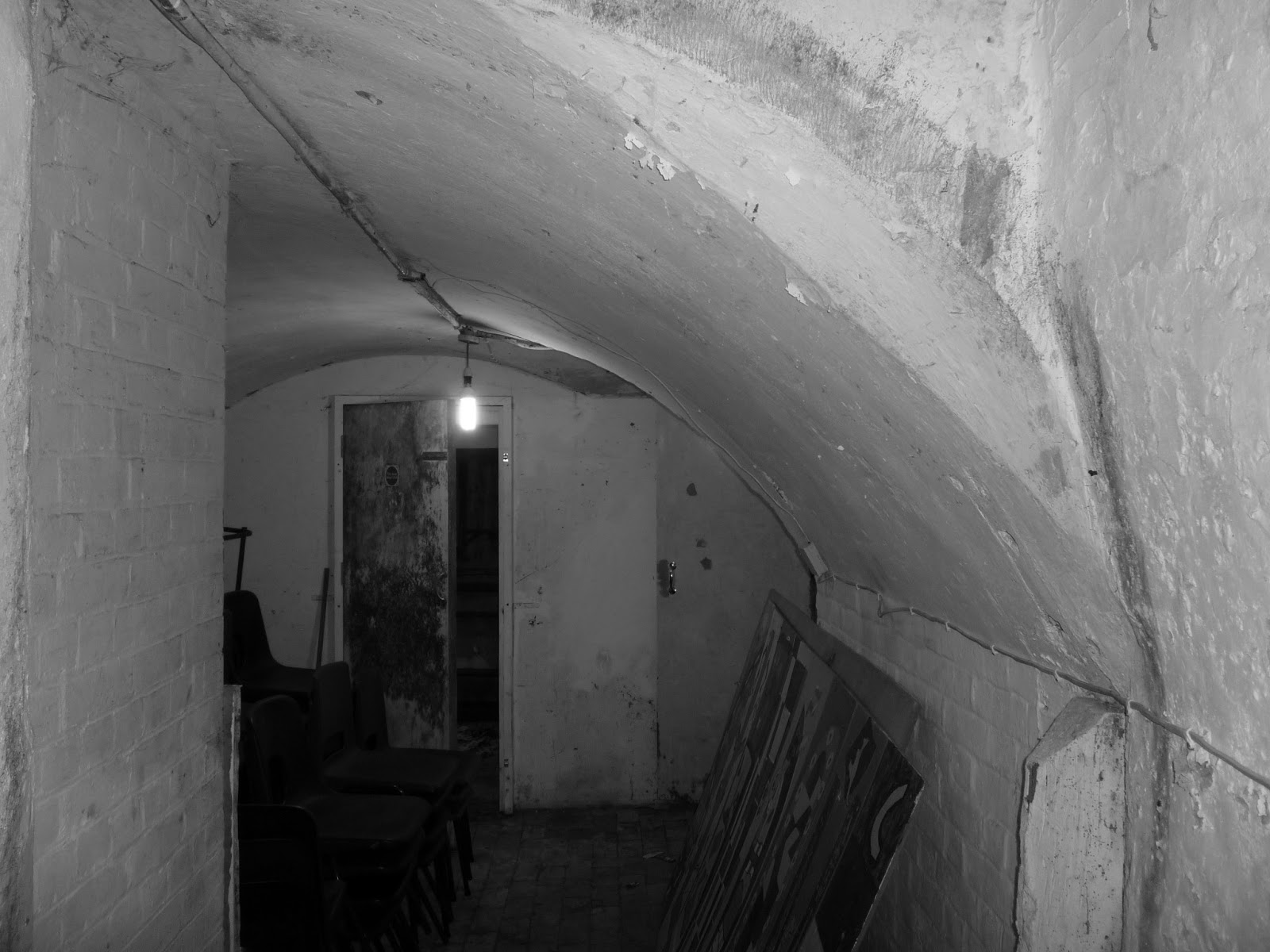
I am about to undertake a detailed survey of the cellars of Slindon House.

From around dates below.

 Period of Archbishop Langton.

  Date. Archbishop of Canterbury between 1207

 and his death in 1228.

There may be signs of an early period yet to be identified.

To, the present day.

So a long period of use, within the area of the cellars you can see early medieval, building work, late periods up until 1600s,.Plus to present day.

The cellars seem to be divided up  into possibly three periods, early, middle and late, late being 1700s to present day including signs of Victorian use, and Edwardian use, such as coal shoots, gas lighting, then later some WW1 signs, and later WW2 reinforcement of the cellars ceilings, plus a ammunition store room. Plus, graffiti of service men’s names. Canadian .

There another very interesting feature of a lift shaft, very ornate, completes with the workings, used to convey Lady Beaumont from the ground floor to the top floor of the present building.

Work will start next Monday and continue for the week, a resistivity survey to the south of the house will take place during this period.
This is an area which shows signs of early foundations of the early building that once stood there.


I am looking for interesting articles for our annual journal, so please put pen to paper, or should i say fingers to keyboard,

I am the Chair of the Friends of Botolphs   Church in the Adur Valley near Bramber, see link,
http://friendsofstbotolphs.wordpress.com/

This church is now in the hands of the Churches Conservation Trust.


Mick Aston is no longer with us, he inspired many, including myself, to me he was the face of Time Team, and to be honest he really inspired me to go further in my studies of Archaeology, and especially the history of Monastery's.
He will be sadly missed, and really so young, rest know. .

Wednesday, May 22, 2013

St Botolphs Church in the Adur Valley is now in the hands of the Church Conservation Trust.

At a meeting last night a formal committee started to take shape , we now have a Chairperson, Secretary, and Treasurer, somehow i ended up being the Chairperson, so still early days, but the basis of the formation of the working friends of the church is now in place.
Membership of the friends will be £10 per year for an individual and £20 for a family membership, there will be newsletters, fund raising events, lectures, music, arts etc.

More news later

Monday, May 13, 2013

Alexander Selkirk - the Real Robinson Crusoe?

Frequently history is stranger than fiction and none more so than in the tale of Alexander Selkirk: the real-life Robinson Crusoe.

Born in 1676, the seventh son of a cobbler, Alexander Selkirk grew up in Lower Largo, Fife. At the age of 19 he found himself in trouble with the Kirk Session after his brother’s trick of making him drink sea water resulted in a family fight. Before his case was heard, Selkirk fled to sea hoping to make his fortune through privateering (effectively legalized piracy on the King’s enemies) against Spanish vessels off the coast of South America.
Within a few years his skill at navigation led to his appointment as Sailing Master on the ‘Cinque Ports’, a sixteen gun, ninety ton privateer. The expedition was a disaster. The captain of the ship was a tyrant and after a few sea battles with the Spanish, Selkirk feared the ship would sink. So, in an attempt to save his own life he demanded to be put ashore on the next island they encountered. In September 1704, Selkirk was castaway on the uninhabited island of Más a Tierra (today known as Robinson Crusoe Island), over 400 miles off the West Coast of Chile. He took with him a little clothing, bedding, a musket and powder, some tools, a Bible and tobacco.

At first Selkirk simply read his Bible awaiting rescue, but it soon became apparent that the rescue wasn’t imminent. He resigned himself to a long stay and began to make island life habitable with only rats, goats and cats for company in his lonely vigil.

After several years of isolation, two ships drew into the island’s bay. Selkirk rushed to the shore, realizing a little late that they were Spanish. Their landing party fired, forcing him to flee for his life although he managed to evade capture and the Spaniards eventually departed.

Finally On 1st of February 1709, two British privateers dropped anchor offshore. Alexander lit his signal fire to alert the ships, who dispatched a rather astonished landing party to find a ‘Wildman’ dressed in goat skins. Remarkably the privateers’ pilot was William Dampier, who had led the Selkirk’s original expedition and was able to vouch for the ‘Wildman’.


Selkirk had spent four years and four months of isolation on the island, yet seemed stable when he was found. The experience had, in fact, saved his life. From William Dampier he learnt that he had been right to leave the ‘Cinque Ports’, which had sunk off the coast of Peru with all of its crew drowned except the captain and another seven men, who had survived only to be captured and left to rot in a Peruvian jail.
Selkirk re-embarked on his career as a privateer and within a year he was master of the ship that rescued him. In 1712 he returned to Scotland £800 richer, and surprised his family as they worshipped at the Kirk in Largo. They had long given him up for dead and were astonished that he was alive, let alone alive in his fine, gold and lace clothes. In 1713 he published an account of his adventures which were fictionalized six years later by Daniel Defoe in his now famous novel: ‘Robinson Crusoe’.


Selkirk, however, could never really readjust to life on the land, and, in 1720, a year after he was immortalized by Defoe, he joined the Royal Navy only to die of fever off the coast of Africa.

Wednesday, May 08, 2013

Great War In The Air - 112 Zeppelins Over England

With the anniversary of the War to end all Wars next year, i am working on aspects affecting Sussex, but thought this may be of interest. .http://youtu.be/mb6x956HTHU


Another great film. http://youtu.be/XJb-rF9k33g

Saturday, April 27, 2013

St Botolphs Church in the Adur Valley is now in the hands of the Church Conservation Trust, the church will be closed later in the year for major restoration work, so now would be a good time to visit this ancient church.
Adjacent to the church on the site of the now modern burial ground ,where once stood the medieval village of Botolphs,the site is still littered with medieval pottery etc.Opposite the church in the fields you can still see the remains of the medieval salt industry,salt mounds are still visible. At a later date i will be undertaking tours of the church and surroundings area associated with the village and church.
Meanwhile do visit this summer, it is open every day from early till late.

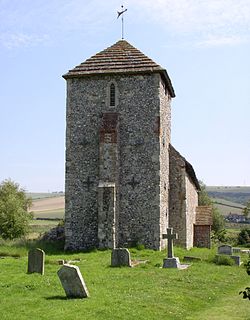
The Grade I listed Saxon church of St Botolph's at Botolphs, West Sussex, England, is situated in the valley of the River Adur and is now part of the Church of England parish of Beeding and Bramber with Botolphs. An earlier dedication to St Peter de Vetere Ponte (St Peter of the Old Bridge) is now lost, like the bridge over the Adur from which it took this ancient name. The church serves the mostly depopulated hamlet of Botolphs in the Horsham district of West Sussex. The church has fragments of medieval wall paintings. Architectural historian Ian Nairn comments that the Jacobean pulpit is "notable in a county which is poor in 17th century fittings".

Wednesday, April 17, 2013

Exciting finds in Slindon House.

A visit to the cellars has unearthed some early Medieval building work, dated to circa 1200s.Vaulting , medieval floor tiles, possible very early chapel.

Slindon was a important deer park at this time, and on the list of, circa 12 Summer residency's of the Archbishops of Canterbury.


It was an occasional residence of Stephen Langton, who died here in 1228, and Archbishop John Pecham spent much time here, holding ordinations in the chapel in 1288 and 1291.

  Archbishop Chicheley confirmed the election of Thomas Ludlowe as Abbot of Battle in 1421 in the chapel.

Now this shows us this was a high statues building, as we can see from the remains.
Lots more to show, this just a taster.    Double click photos to enlarge.


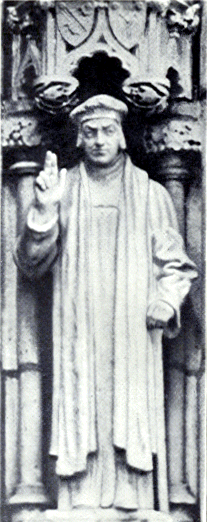
Stephen Langton

Stephen Langton,  (died July 9, 1228, Slindon, Sussex, Eng.), English cardinal whose appointment as archbishop of Canterbury precipitated King John’s quarrel with Pope Innocent III and played an important part in the Magna Carta crisis.
Langton, son of a lord of a manor in Lincolnshire, became early in his career a prebendary of York. He then (c. 1181) went to Paris and, having graduated from that university, he served there for 25 years and established a reputation as a great preacher and a major scholar and theologian. Pope Innocent III then summoned him to Rome and in 1206 created him cardinal-priest of St. Chrysogonus. Immediately afterward Langton was drawn into the vortex of English politics.
After the death of Hubert Walter (1205), a dispute immediately arose as to who should be the new archbishop of Canterbury; but after two years of political turmoil involving king and clergy, the Pope suggested that the suffragans of Canterbury elect Langton, who was consecrated at Viterbo on June 17, 1207. King John, however, refused to allow the new archbishop access to his province, seized the revenues of Canterbury, and banished the monks; Innocent replied by laying England under an interdict (March 1208). Langton crossed to Dover (October 1209) in an attempt to achieve negotiation with the king, but John would go no nearer than Chilham, Kent, and after a week the archbishop left the country, and John’s excommunication was published (November 1209).
By 1212 John was seriously planning the recovery of the French territories lost to Philip II in 1204. The need to embark on this enterprise unhampered by ecclesiastical censure, Innocent’s threat of deposing him, and the news that Philip was planning (April 1213) an invasion of England finally caused John to submit. He at once agreed to receive the archbishop, and Langton, who had been residing mainly at the Cistercian abbey of Pontigny, crossed to England (July 1213) and absolved the king.
Langton was not only associated with the baronial opposition against King John; he advised and supported it, suggesting that the barons take their stand on the coronation oath and the charter of Henry I. Later he withdrew, disapproving violent means, and at Runnymede (June 1215) appeared as one of the king’s commissioners. He therefore probably influenced such “non baronial” clauses of Magna Carta as the one confirming ecclesiastical liberties. During 1218–28 he supported Henry III’s party, being responsible for the 1225 reissue of Magna Carta, and that year convened a clerics’ council to determine a grant to the king. He was responsible for the recall of the papal legate, and during his life no other one resided in England, thus strengthening the archbishop of Canterbury’s claim to be legatus natus (a legate in his own right). In 1222 he also promulgated some important constitutions.


Peckham, John (C. 1225–1292)

John Peckham, or Peckham, the English philosopher and theologian, and defender of Augustinian doctrines, was born in Patcham, near Brighton, Sussex. Educated at the monastery at Lewes, he continued his studies at Oxford and Paris, and sometime during the 1250s he joined the Franciscan friars at Oxford. Subsequently he became a master of theology in Paris in 1269 and returned to Oxford in 1272. Peckham was provincial of the English Franciscans from 1275 to 1277 and then lectured at the papal court for two years. In 1279 he was appointed archbishop of Canterbury and held this office until his death.